Showing posts with label sundays with the classics. Show all posts

Monday, July 22, 2013

"I'm ready to believe in hell, but without a ceiling." (Quotent Quotables)

So you want to be a monk? ... Well, it's a good opportunity. You'll pray for us sinners; we have sinned too much here.  I've always been thinking who would pray for me, and whether there's anyone in the world to do it.  My dear boy, I'm awfully stupid about that.  You wouldn't believe it. Awfully.  You see, however stupid I am about it, I keep thinking, I keep thinking -- from time to time, of course, not all the while.  It's impossible, I think, for the devils to forget to drag me down to hell with their hooks when I die.  Then I wonder-- hooks?  Where would they get them? What of? Iron hooks? Where do they forge them ? Have they a foundry there of some sort? The monks in the monastery probably believe that there's a ceiling in hell, for instance.  Now, I'm ready to believe in hell, but without a ceiling.  It makes it more refined, more enlightened, more Lutheran that is.  And, after all, what does it matter whether it has a ceiling or hasn't? But, do you know, there's a damnable question involved in it? If there's no ceiling there can be no hooks, and if there are no hooks it all breaks down,which is unlikely again, for then there would be none to drag me down to hell, and if they don't drag me down what justice is there in the world? Il faudrait les inventer, it would be necessary to invent them, those hooks, on purpose for me alone.

-- The Brothers Karamazov

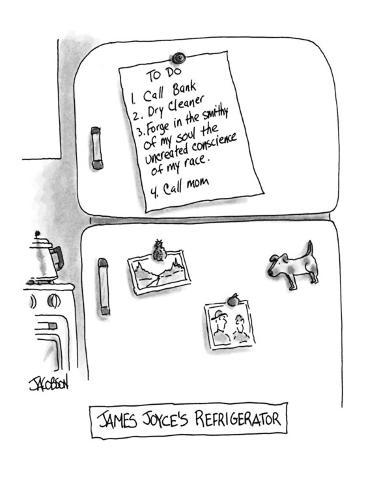
Sunday, April 21, 2013

I'm too old for this crap. (Sundays With The Classics)

I really think this time I might quit reading Ulysses for good.

I have rarely given up on a book, because I don't like to start a book and then stop a book, but I honestly cannot see the point of continuing to struggle through this book.  Why am I doing it? I keep asking myself.

Once a week, I force myself to sit down and read one of the current classics, and I use that term loosely, and in that sentence, or I suppose it's a clause, there is the root of the problem:  I force myself.

Has anything good ever come of being forced to partake of entertainment? I say no.  Forcing someone to do something almost certainly deprives that thing of any entertainment value and virtually guarantees that the person will not like it.  Consider an example: suppose you are doing something.  Reading, or watching tv, or juggling, or whatever, and someone hollers at you and says "Hey, come look at/listen to/smell/experience this book/video/shoe/thing I found."  Are you predisposed to enjoy that thing? Not if you are me.  If you are me, you are probably annoyed at the person and think "Oh, god, here's two minutes of my life gone now," which says a lot about me, a lot about the kinds of things people foist off on me, and probably very little about real people and/or the real world.

But that is me, and that is the problem:  I am not enjoying Ulysses anymore, and haven't for a long time and I feel, at 35% of the way through a book, that I have given it a fair shake to turn into something and it's not.  It's really not.  It's so far away from turning into something enjoyable, in fact, that I cannot conceive of the set of circumstances under which this book would become meaningful for me to read.

The latest, and last, installment that I read consists of exactly the same freaking thing that all prior installments have consisted of.  Want to write a James Joyce novel? Here is how you do it:

A. Think of a character.
B.  Now think of 753 other people with vaguely similar sounding names.
C. Now give all 754 of your people nicknames they will use for each other.
D. Begin talking about your "main" character.
E. Randomly skip from the main character's 'adventures' to things the other 753 people are doing.
F. Introduce roughly 200 new people, all at once.
G. Have you made up some of your own words to use? Try that. It's fun!
I.  Remember that main character? So does the reader. MAKE SURE HE DISAPPEARS FOR LENGTHY PERIODS OF TIME.
F. In fact, screw the reader? Is he still working on making it through the book? Time to shift perspectives, sometimes in the same sentence! MAKE HIM WORK FOR IT.
G. Now mention that the sky is blue.

That is a James Joyce book.


There is no point to this, or at least none that couldn't have been made in a short story that might have been mildly amusing.  There is no plot structure. There is no imperative taking the reader forward.  I think it has been months, in real time, since I heard from Bloom and I cannot even remember what it was Bloom was doing.

I tried treating this book as poetry, enjoying it for the language, as I was told to do by someone, but there is a limit to even the amount of 'poetry' I can take, and I'm giving up.

I get it, James Joyce. Things were grim for Dubliners.  They were poor. They had lively minds. They thought about sex and God and death. And the town was dirty.  Or I assume I get it, because if I have gotten any meaning from your book, it was in spite of you, not because of you.

It's not even that the book was written a hundred years ago or something like that.  I mean, I know that some books are harder to read because writing styles were different and language shifts and all, but this book was written around the time that Mark Twain was writing and... probably other people were writing, too, and I've read older stuff than Joyce, and didn't find it so comically bad.  It's not like the book is 400 years old and written in old English.  It's just deliberately hard to read, and what is the point of that? Why work to make your book more difficult to read than it has to be?

I'm sitting here, and I'm actually getting more than bored, I'm getting a little annoyed, that I've spent so long working on this book, waiting for it to become something that was worth my time, something that I wasn't working to read, and it has not.  And I'm 44 years old, and I work 50 hours a week and have household chores and obligations that take up a lot of my time, so I haven't got an infinite amount of time for entertainment, and I get annoyed when some of my entertainment time is taken up with something that completely fails to be worth my while, as this book has.

When I began this post, I wasn't 100% sure I was going to quit.  Or at least I thought I wasn't 100% sure, but looking back on this, I think my mind either was made up and I didn't want to admit it, because it feels like quitting.  I don't like to quit, and I don't like to think that everyone else in the world, or at least that portion of everyone else in the world who has read Ulysses is smarter than me or better than me because they were able to read this stupid book and (maybe?) enjoy it.  But I suspect that many people who claim to have read Ulysses either did so because they were forced to or did it out of a sense of obligation, the way I picked it out, originally -- "This book is famous I must be supposed to read it"-- or maybe they're lying.  I'd be hard-pressed to believe that someone read this book purely voluntarily and also enjoyed it.  If someone made that claim to me, I'd be suspicious of them and not like them much, the way I am when people say "I never watch television."

And if everyone's reading it because we think we're obligated to read it, WHY?  I made this point a long time ago when I did a post about the crappy books we're foisting off on kids in schools, the point being that whatever merits you think you are teaching, there are better ways to teach them than forcing kids to read something.  Want to teach kids about star-crossed lovers? DO NOT USE ROMEO AND JULIET, it is hard to read and frequently boring.

Want to teach people about life in Dublin at the turn of the century, Ditto Joyce. Which would make a good name for a character in a story and I may use that one of these days, but I digress.

I am not against difficult-to-read.  Possibly one of the most difficult books I ever read was Foucault's Pendulum, by Umberto Eco, a book that was dense with mythology and which drops the reader in at the near-end of the story and the circuitously loops back around to tie everything together, and it was extremely rewarding, but that is because there is "Difficult-to-Read" in the sense that the topics are weighty and the story is complex and so forth, and there is then "Difficult-to-Read" in that the story is poorly written and stupid and made hard to read solely for the sake of being hard to read, like the way David Foster Wallace managed to make a joke of a book (literally; it was called Infinite Jest) and have critics adore it probably mostly because of the Emperor's New Clothes effect.  I put Joyce into that latter category.

And so I'm giving up on Ulysses, and, as I think of it, I'm giving up on The Odyssey, too.  I have just punched the button to remove Ulysses from my Kindle and... *pause* now I've done that with The Odyssey, too, which is not nearly as satisfying as I thought it would be, in that the little icon still remains there, staring implacably at me, so probably I should've gotten a physical copy of the book just so I could have thrown it out, like I did with Infinite Jest, the ultimate review.

There will be a new Classic, soon, that I'll begin working on.


Here's another link to that post I mentioned: The Five Best Books Schools Should Have Kids Read (And The Five Crummy So-Called Classics They Would Replace)

Friday, April 12, 2013

Remember that gross part with the eye? This is grosser, and not in the cool way. (Sundays With The Classics)

Back to The Odyssey, as I continue to alternate between Homer's epic poem and the book Ulysses which is supposed to be based on Homer's epic poem but which so far as I can tell is based on everything but Homer's epic poem.

But this post is based on Homer's epic poem, and specifically about what I believe is the first ever incidence of an #Occupy movement bringing down the 1%, and also how the 1% are pretty disgusting, which we kind of suspected, right? I mean, we kind of always suspected that, right?

Yes. Yes, we did.

When last we left Odysseus, he was trapped in the cave of Polyphemus, who had been blinded, and left to die by his (Polyphemus') gods-fearing fellow cyclopi  (I was going to go with cyclopses, but how could I miss tacking a single i onto that word?)

(Get it?)

Odysseus is trapped in Polyphemus' cave, and devises as a plan to get out that they will hang onto the sheep from below to sneak past Polyphemus, who for some reason pats each sheep on the back as it walks out of the cave.

So let's think about that.

Polyphemus is aware that Odysseus, and his remaining (i.e., "not eaten") men are in the cave and that they can only get out if he moves the rock.  But Polyphemus is blind and can't find Odysseus.

So he moves the rock.

I mean, cyclopi

(I'm really onto something there.  It's cracking me up.  Well, I mean, it's making me smile a bit, which is making Mr Bunches, who is sitting across from me, wonder why I'm smiling.  BACK TO OUR ESSAY!)

aren't supposed to be the smartest tools in the barrel, I guess, but why wouldn't Polyphemus, oh, I don't know, search everywhere in the cave as best he can or maybe just pound everything with a giant fist until he kills something, or at least try that before he opens the cave?

But then, once he does open the cave, Polyphemus is able to realize that this means Odysseus and the fellas might sneak out, so he manages to block the cave door... somehow... to only let one sheep through at a time, or so one would think but he doesn't, hang on for that.

Then Polyphemus thinks "what if they try sneaking out by riding on a sheep," so he cleverly (only not really) pats each sheep on the back as they go out, and so Odysseus and the guys sneak out by clinging to the sheeps' bellies?  And Polyphemus never figures that out, either?

ALSO: Odysseus tied the sheep in threes to let his men sneak out, presumably, I'm guessing, because one sheep isn't strong enough to carry a whole Ithacan, so that blows the whole idea because now the sheep are marching out past Polyphemus in perfect three-by-three procession that would make Colonel Scheisskopf proud.*

*Catch 22 reference.

And having snuck out, with Odysseus sneaking out by hanging on the bottom of the prize ram, you'd think they'd leave well enough alone, but Odysseus taunts Polyphemus from afar, causing Polyphemus to rip the top off of a mountain and throw it, nearly sinking the ship, and when they narrowly avoid that, Odysseus then taunts him again, over his crew's protests, and gets another mountain thrown at them which splashes them back onto the beach and makes them sit and have a barbecue for a night before leaving, so that's not all bad, I suppose, except at every beachfront barbecue I've been to, someone plays reggae music and after about 48 seconds, reggae music gets monotonous and irritating and that's even before all the frat boys in their baseball hats with straight brims begin singing No Woman No Cry offkey and spilling their Bud Lite Limes onto their Reeboks.

Things get worse, then, a bit, and by "worse" I mean both "worse for Odysseus, because he is a greedy one-percenter and/or the takers on his ship don't understand how job creation works [depending on your political viewpoint]" and also I mean "worse, as in good God, Greeks, you were disgusting."

The one percent stuff: Odysseus visits an island or something where they outfit him with more ships and because he's such a happening guy they give him a bag of wind, capturing the zephyrs in a bag so that he can use them to sail to Ithaca (I've been saying Ithaca throughout this post but it just now occurs to me that I'm not entirely sure if Odysseus if from Ithaca.  On the other hand, I'm clearly too lazy to go check it out, so let's just keep on saying Ithaca.)

(NOTE: My Kindle is literally 7" from my hand as I write this.  I was not kidding about the "too lazy.")

So Odysseus keeps the bag of wind a secret from his loyal men who are after all not his men -- they were borrowed from the land of Riverdancers, remember -- but they are loyal enough to him to literally row him all over the world, so you'd think he would say "Hey, just so you know, if things get becalmed I've got this bag of wind that we could open and blow the ship where we need to go even though that would clearly not work because for every reaction there is an equal and opposite reaction, so the wind would push the sails forward with the exact same force that the man holding the bag would be pushed backward, so either the ship would remain motionless or the man holding the bag would have to be left behind on a solid piece of ground or something but Newton's laws have not yet been discovered, we're still in an era where we think "earth" is an element, so CARRY ON!"

Where was I?

And Odysseus and his men ARRIVE AT ITHACA IN THIS VERY CHAPTER, they see it and it's all aglow with the home fires but for some reason they do NOT land and welcome Odysseus home, probably because that would make for a very short epic poem, and instead they anchor overnight offshore and Odysseus goes to sleep and the Not His Men find the bag he got and mutter something about how Odysseus is a king and everyone loves him and why should he get all these riches and they decide to get some of the gold out of the bag, but the bag is the Bag O' Wind, which they open and it blows them completely back to the kingdom they'd left which gave them the Bag.

Does Odysseus explain to them what happened?

He does.

Do they graciously say "Well, that's an error that could happen to anyone, here, camp out overnight, let's roast a sheep and sing No Woman No Cry?"

They do not. They get mad at him and kick him out.

Why are these people so mean? Not just because Odysseus once strapped Polyphemus to the top of the Trojan Horse to drive on vacation, or something, but probably because they are disgusting people.

Let's show Exhibit A in how disgusting the Wind Gifting People are.  Here is how they are introduced:

We came to the Aeolian isle; there dwellsAeolus, son of Hippotas, belov'dBy the Immortals, in an isle afloat.A brazen wall impregnable on all sides Girds it, and smooth its rocky coast ascends.His children, in his own fair palace born,Are twelve; six daughters, and six blooming sons.He gave his daughters to his sons to wife;They with their father hold perpetual feast

But it's not all superincest-y:

And with their consort chaste at night they sleep
On statliest couches.

So, you know, before you get too creeped out by a dad commanding his six daughters and six sons to marry, it's okay: they sleep chaste.

Ecch.

This installment ended the way it began: After being chased off the Land Of Incest for having the gall to have accidentally been blown back there by his money-grubbing men, the men sail to a land where they roam into a palace only to be confronted by a queen

In size resembling an huge mountain-top,
A woman, whom they shudder'd to behold
She forth from council summon'd quick her spouse
Antiphatas, who teeming came with thoughts
Of carnage, and arriving, seized at once
A Greecian, whom, next moment, he devoured.

Out of the frying pan, into the fire, and by "fire" I mean "Yet another land where giant people eat the Greeks and throw rocks at ships."

PS: I should note that I am fully aware that the picture that leads this post does not accurately reflect the actual way the Greeks escaped Polyphemus, and in fact it makes Polyphemus look not so much like a Giant Cyclops as just "A really big guy." Why an artist would choose to make The Odyssey less interesting is beyond me.  That picture ought to be titled "Some Guys Sneaking Out of Andre The Giant's Boring Survivor Watch Party."


Sunday, March 31, 2013

Reality TV, James Joyce-style. (Sundays With The Classics)

More death, or near death, in today's installment of Joyce's Ulysses. But also sex! Of course! And they're intermingled, to make you uncomfortable.

A couple of guys at the outset of today's part are playing some kind of gambling thing.  On their way to the bookie's, they stop to demonstrate how Tom Rochford, a guy they know (?) saved someone, a man who had been stuck in a drainpipe,

the poor devil stuck down in it,  half choked with sewer gas.

They walk on and as they do

M'Coy dodged a banana peel with gentle pushes of his toe from the path to the gutter.  Fellow might damn easy get a nasty fall there coming along tight in the dark.

Which I thought was an extreme example of the death that waits everywhere in Bloom's life: slipping on a banana peel, the stock joke, is not funny, it's a "nasty fall" because even funny (?) things are killers in Ulyssesi.

Then there is a break from the death for one of the characters, I don't even know who at this point, it's just all a hodgepodge of people walking around, to tell a story that's prompted by watching a guy buy a book.

There is a guy buying a book, and the walkers comment on how the bookbuyer loves his books, and then one of them mentions the bookbuyer picking up a book about astronomy, and another says

I'll tell you a damn good one about comets' tails,

Which I just assumed was a 1910 off-color reference about women's butts.  Only I think I was wrong by about the length of a torso, as this guy launches into a story about a feast where Bloom, remember him, he's the main character and hasn't been around in a while, and Bloom's wife are at the feast, and then after they are all heading out, at

blue o'clock in the morning,

Which is a phrase I really liked and which I only just now realized might refer to "blue balls," given that there has been a party and given what happens next, as the guy says this:

Bloom and Chris Callinan were on one side of the car and I was with the wife on th eother.  We started singing...Every jolt the bloody car gave I had her bumping up against me.  Hell's delights! She has a fine pair, God bless her. Like that.

Yes.  God bless her fine pair!

Also, when the guy says "Like that" Joyce goes on in the paragraph:

He held his caved hands a cubit from him, frowning:
-- I was tucking the rug under her and settling her boa all the time. Know what I mean?
His hands moulded ample curves of air. He shut his eyes tight in delight, his body shrinking, and blew a sweet chirp from his lips.

You know, in case you were wondering how big Bloom's wife's fine pair was or what was going on there.

A cubit, by the way, is generally considered to be the length from your elbow to your hand, sometimes your index finger.  It comes from the word for "elbow," but also from the word for "lie down," so Joyce is being very clever, and also extremely generous, with the three cubits' of bosom.

Then there is the joke I didn't get, as the friend finishes up the story:

-- The lad stood to attention anyhow, he said with a sigh.  She's a gamey mare and no mistake.  Bloom was pointing out all the stars and the comets in the heavens to Chris Callinan and the jarvey: the great bear and Hercules and the dragon, and the whole jingbang lot. But, by God, I was lost, so to speak, in the milky way.  He knows them all, faith.  At last she spotted a weeny weeshy one miles away.  And what star is that, Poldy? says she.  By God, she had Bloom cornered.  That one, is it? says Chris Callinan, sure that's only  what you might call a pinprick.  By God, he wasn't far wide of the mark.

What, now? I don't get it at all, but it's funny because Joyce says so, in the next paragraph:

Lenehan stopped and leaned on the riverwall, panting with soft laughter.

I mean, I assume it's a joke at some guy's expense, as I am not completely unaware of the second meaning that could be ascribed to the word "pinprick," but at whose expense? Bloom's? The friend/date rapist?

It made me feel exactly like when I watch the British version of The Office: I know that something, somewhere, is a joke, but I don't know which part, or why, the joke is.

I actually think Bloom was the bookbuyer, though, because after that story,  it went back to Bloom's point of view, and he was buying a book.  Also, it goes back to death.  Bloom is looking at two books, "The Awful Disclosures of Maria Monk" and "Aristotle's Masterpiece," and he thinks:

Crooked botched print.  Plates: infants cuddled in a ball in bloodred wombs like livers of slaughtered cows.

Got that? Forget all your levity of feeling up a friend's wife on a drunken trolleyride home.  It goes on:

Lots of them like that at this moment all over the world.  All butting with their skulls to get out of it.

Which is actually about birth but doesn't seem like that, does it? Not many people liken their newborn kids to the liver of a slaughtered cow.

The bookseller then gives him some other books, and Bloom decides to pick up a little Mommy Porn:

He read the other title:  Sweets of Sin.  More in her line.  Let us see:

He read where his finger opened:

-- All the dollarbills her husband gave her were spent in the stores on wondrous gowns and costliest frillies.  For him! for raoul!

Yes. This. Here. Try.

-- Her mouth glued on his in a luscious voluptuous kiss while his hands felt for the opulent curves outside her deshabill?

Yes. Take this. The end.

It's not "the end" exactly, but we've all been there, right, standing in the line at the grocery store ready to pick up that Aristotle book but you just happen instead to pick up a romance, too, and next thing you know you're lost in... let's say thoughts... and buying the porn.

We've all been there, but no need to be ashamed because, thanks to Joyce, you're just being literary.  It's like buying porn qualifies you for a B.A. in English, now.

Anyway, it is not long before we're back to death.  Bloom reads some more, imagines some sex, and then there's a brief interval as an old lady leaves court and then the bookseller is coughing like he's dying and Bloom watches him hawk up a massive loogy:

He raked his throat rudely, puked phlegm on the floor.  He put his boot on what he had spat, wiping his sole along it, and bent, showing a rawskinned crown, scantily haired.

That guy needs a marketing guru, someone who could tell him that puking phlegm onto the floor isn't possibly the best way to run a booksellers.  Look what happened to Borders when they tried that!

I tried to go see if "Sweets Of Sin" was a real book, because my anniversary is coming up and nothing says romance like outdated porn with a literary twist to it, but I couldn't find it anywhere on Google, which effectively means it does not exist, as all the results are of literary scholars quoting liberally from this part of Ulysses, imagine that!

(And imagine someday if Fifty Shades Of Gray is deemed a literary classic so that someone a hundred years from now is blogging about the 'classics' and giving Fifty Shades this treatment?  Will Fifty Shades' more explicit [I assume, I haven't read it] descriptions seem as quaint as deshabill and the comet's tails? Will that blogger blog using only his mind? Will humans have colonized the stars by then?)

(The answers are Yes, yes, and seven.)

The Awful Disclosures of Maria Monk was, it turns out, a real book.  Here is the description of it:

The Awful Disclosures of Maria Monk, as Exhibited in a Narrative of Her Sufferings During a Residence of Five Years as a Novice and Two Years as a Black Nun, in the Hotel Dieu Nunnery in Montreal was first published in January 1836. Its coming was much anticipated, having been announced some months prior in the nativist newspaper, the American Protestant Vindicator. The book was written by a former nun who had escaped from the Hotel Dieu nunnery in Montreal. It promised to expose the iniquity of the Catholic convent system. The book was as sensational as it promised to be, and immediately became a rallying point for the nativist movement. According to theProtestant Vindicator, by the end of July, 1836 it had already sold over 26,000 copies. By the start of the Civil War, it would have sold 300,000 copies. It was reprinted, under varying titles by various publishing houses, at least half a dozen times just in 1836, and continued to be reprinted well into the twentieth century. A second work, Further Disclosures of Maria Monk, sold well also, and was reprinted several times, along with various other works refuting or supporting her claims. Quite an industry was born out of Maria Monk's story.

We are living in an age when people both decry and celebrate "reality."  Reality TV and memoirs dominate the pop culture, even inventing subgenres, such as the "faiulre" memoir popular among authors right now (The New Yorker reviewed three or four last week, nonfictiony books by authors who had failed to get published or failed to get more published, and then published a book about their failure to publish, which is the literary exact equivalent of Doritos planning to make a Doritos chip flavored like Doritos Tacos Locos, which are of course tacos flavored like Doritos, so now you can buy chips flavored like tacos flavored like chips to eat while you read a book by an author writing about how he couldn't get a book published, all of which means time and space have been inverted.  CURSE YOU HIGGS BOSON!

But back in Bloom's day The Awful Disclosures of Maria Monk spawned an industry of tell-all revelatory reality, including forced sex with priests:

The Superior now informed me that having taken the black veil, it only remained that I should swear the three oaths customary on becoming a nun; and that some explanation would be necessary from her. I was now, she told me, to have access to every part of the edifice, even the cellar, where two of the sisters were imprisoned for causes that she did not mention. I must be informed that one of my great duties was to obey the priests in all things; and this I soon learnt, to my utter astonishment and horror, was to live in the practice of criminal intercourse with them.
And, like Jonathan Frey and that "Three Cups of Tea" author, Maria is a liar.  That site says:

The first thing you have to understand about the Awful Disclosures is that they are not true.

And goes on to say how Maria Monk's story was true, kind of, in that she had an awful life, beginning, the site says, with

a brain injury suffered when Maria was little more than a toddler: a slate pencil was rammed into her ear, penetrating her skull. From that time on, according to her mother's testimony, Maria was uncontrollable and subject to wild fantasies. Her only known contact with a Catholic institution was as an inmate of the Magdalene asylum in Montreal. When it was discovered that she had become pregnant while resident in the asylum, she was asked to remove herself from that institution. 

Some of that came from an affidavit from her mother.  

Anyway, Bloom is reading those books and considering between buying Awful Disclosures and the Aristotle book, but decides that he will buy the Sweets of Sin, and all of that happens just after Bloom's friends describe him as a real artsy guy:

He's a cultured allroundman, Bloom is [the friend said] seriously.  He's not one of your common or garden... you konw... There's a touch of the artist about old Bloom.
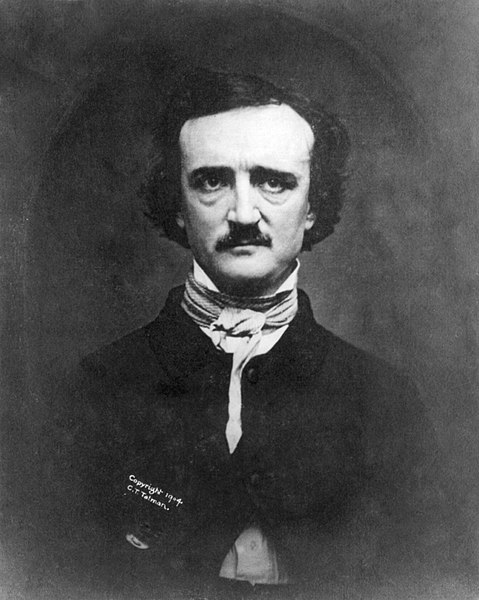
So Bloom's got his friends fooled, it seems.  But honestly,  given a chance, wouldn't we all read Awful Disclosures or Sweets of Sin over Aristotle? I know I would.

Thursday, March 21, 2013

Outis gets this joke. (Sundays With The Classics)

I sat down this morning to read The Odyssey, and I got about three sentences into it before I had to pause and think about this because I do not get the joke here.

Here is what happened:: remember, Odysseus stabbed Polypheme in the eye with a log, which maybe is the genesis of our saying that something is "better than getting poked in the eye with a sharp stick."

Let's think about that first: how did that become a saying?

This page, which seems to promise an answer to that question, not only doesn't answer it at all, but makes things worse by suggesting that "poke in the eye with a sharp stick" is indigenous to Australia, so yeah I get that, there's nothing else to do down there except wait until you die from the giant spiders that infest everyone's house to the point where even kids just accept that they will die in a SpiderGeddon:


But beyond that, that site claims that there are similar sayings in Canada and the US (literally, "us"), which it claims are:

Canada:  "Better than a kick in the ass with a frozen boot."

US:  "Better than a slap across the belly with a wet fish."

And now I'm just mad.  Because (A) those three things are in no way comparable. De-eyeing versus getting kicked with a frozen boot or slapped with a fish? No.  And (B) I have lived in the US for 99.9% of my life, and I have never heard anyone say that something was "better than a slap across the belly with a wet fish."  Never.  I sincerely doubt that is a saying, and I think the person who posted it on the Internet it deranged.

That said, I plan on using that saying as often as possible.

Anyway, Polypheme got poked in the eye with a sharp stick, leading to today's installment of The Odyssey in which two lines in I got confused and outraged (literally, "my ordinary state of existence") (or "nonplussed") (Oh, man, I only just realized that my reaction to the differing definitions of nonplussed was itself a definition of being nonplussed.  I AM AWESOME.)

Today's installment begins, and ends, with a few lines, because in those few lines, Polypheme calls for help from all the Cyclops around on the island, bellowing out with his pain and hurt from inside his cave which remember is blocked by a rock and is dark.  And as his friends gather, Polypheme says:

"Oh, friends, I die! and Outis gives the blow."

and the other Cyclops reply:

"If no man harm thee, but thou art alone,
And sickness feel'st, it is the stroke of Jove,
And thou must bear it...."

And Odysseus thinks to himself:

"...in my heart I laugh'd"

Let me pause again to say: okay, why get rid of the "e"?  Laughed is one syllable.  One. Using the apostrophe, which I've previously noted is a poetic dodge because we all pronounce the other syllable:

syllable

syl'ble

but we give the poet credit for fitting into the meter, so it's a poetic TKO, using the apostrophe is not necessary for laughed because nobody pronounces it

laugh-phed

It's just

laft.

So this is not a Homer problem, because I doubt that he apostrophized the original Greek word, which is


γέλασε
gélase


According to Google, which ought to know.  This is a problem on the part of the translator, and I don't know who he is, so let's move on to the original point before you get bored and go home.

The original point is that after Polypheme says "Outis" stabbed him, "Outis" being Odysseus' alias in the cave, the other Cyclops tell him that he was hurt by nobody and Odysseus thinks:

"...I laugh'd [NOTE: ARRRRRRGGGH]
that by the fiction only of a name,
Slight stratagem! I had deceived them all."

And I had to stop and think, because I don't get it.

Outis must mean something that is entirely lost on us, right? Like when my dad makes any joke about anything, the frame of reference isn't there.

DAD:  "So your car isn't working?"

ME:  "Yeah."

DAD:  "Sounds like an Eisenhower thing to me!" [Laughs.]

ME: "This is why I don't visit."

So I paused and determined to look up the Outis reference.

And it turns out it's easy.

And stupid.

"Outis" is Greek for nobody, so Polypheme is literally yelling at his friends that he is dying and "Nobody" did it to him, and so they say "Well, then, that's your problem so maybe pray to Neptune to help you out," which raises several important questions:

1.  Why didn't Polypheme recognize that "Outis" meant "nobody" when Odysseus first claimed that was his name?

2.  Why didn't the Cyclops try to help Polypheme anyway? What is it about Greek culture, or Cyclops culture anyway, that you only help people who have been killed by a third party and not those who are suffering from some internal ailment?  "Did someone do this to you? No? Then I've got to go, Modern Family is starting and it's the one where Cam and Mitch at first seem to fight against gay stereotypes, only to then embrace them." (Literally: Every show.)

3.  Why would Edgar Allan Poe write a denunciation of William Wordsworth and then turn around and write an anonymous defense of him, as Wikipedia claims happened?

Edgar Allan Poe (1809–1849) In the New York Evening Mirror (January 14, 1845), Edgar Allan Poe launched an article denouncing the well-known poet Henry Wadsworth Longfellow as a plagiarist. Longfellow remained silent on the matter, but a defender for Longfellow did appear, an anonymous writer who signed his letters only as "Outis," meaning "nobody." A great deal of speculation has centered around the identity of Outis, several scholars agree that he was none other than Poe himself.[citation needed] They believe that Poe himself wrote the defense of Longfellow, so Poe and Outis are the same person.

Poe has done some supercrazy things, in his life.  But that seems weird even for him.

Saturday, March 02, 2013

Another Sunny Day... so what went wrong? (Sundays With The Classics)

Today was a Ulysses day.  And as usual, not very much happened.  At the outset of today's segment, Father Conmee is getting over some racist thinking about how yellow and black people aren't going to heaven, and he glances out the window and sees a woman walking and muses to himself about how she is probably having an affair with her husband's brother but she won't really confess it -- she'll only half confess it -- and then he wanders around reading his Nones, which are prayers that are supposed to be read at 3 p.m.  As he walks around, musing about how great the day is, a young couple comes out of the hedge, and I'm pretty sure they were supposed to be having sex.

Joyce then does his usual "Everything good eventually leads to death" by abruptly cutting to Corny Kelleher, who is making a coffin lid.  It's not even very subtle, the sudden transition from "hey, here's a young couple snuck out of the hedges" to "Here's Corny Kelleher making a coffin lid," and for the rest of the time I read, the scene just jumped around: a mother and daughter complain about how the rag dealer didn't offer them anything for their rags and eat pea soup, the daughter (Boody) saying a prayer:  Our father who are not in Heaven as a complaint about how little food and money they have (and getting yelled at by her mother), a man buying a fruit basket to send to an invalid while he looks down the blouse of the girl who is putting it together and makes ribald (?) puns (asking to speak into her telephone when she catches him looking), some people talking about the news, a group of tourists going by, and so on.

Joyce does let us know that all this is happening at the same time through a bit of a literary trick: as Father Conmee is saying his nones and the couple is coming out of the hedge, Joyce writes that the woman picks a twig off of her skirt, and later in the chapter, after much comings and goings, Joyce writes that exact same sentence, which I took as a callback to the earlier part of the chapter; it's a neat little trick to say "This is all at once," without saying "This is all at once."

But that's really it, for this installment.  There wasn't anything remarkable, or even particularly poetic, or memorable, really.  The whole installment had a light, almost airy feeling to it, and even Joyce's constant reminders of death and poverty and the probable lack of a God couldn't really dampen the atmosphere of a pleasant afternoon just after lunch, and I suppose maybe that was his point.

He begins, anyway, with Father Conmee feeling benevolent, if not beatific, praying and even blessing the couple that was probably messing around and musing about how great life is, and moves through a series of people who are buying stuff for sick relatives or friends, or making coffins, or desperately wishing they could've sold some rags so they didn't have to subsist on charity-pea-soup from the nuns, and the entire picture is both one that is grim (people are sinning, and dying, and being poor) and amazingly bucolic -- so much so that the daughter's "prayer" about God not being in Heaven has a double-edge to it: a girl trying to get her mother's goat, and a girl reminding people that for all this apparent surface pleasantry, life is remarkably tough and that everything leads to death, even a pleasant afternoon.

Which, as I sit here on my own pleasant afternoon, is not a particularly fun thought to leave on.

Joyce isn't the only one to see a grim ending to a pleasant afternoon:

.
But I'm not letting Joyce, or Belle & Sebastian, bring me down.  I am going to eat some pizza, goddangit!

Wednesday, February 20, 2013

So gross. (BUT ALSO VERY COOL) (Sundays With The Classics)

Here is the last part of The Odyssey I read today:

They, seizing the hot stake rasp'd to a point
Bored his eye with it, and myself, advanced
To a superior stand, twirled it about.
...
So grasping hard the stake pointed with fire,
We twirl'd it in his eye; the bubbling blood
Boil'd round about the brand; his pupil sent
A scalding vapour forth that sing'd his brow,
And all his eye-roots crackled in the flame.
As when the smith an hatchet or large axe
Temp'ring with skill, plunges the hissing blade
Deep in cold water...
So hiss'd his eye around the olive-wood.

It's the part where Odysseus and four of his men take the six-foot long (I know it's six feet long because they say they cut the log to a "fathom" and a "fathom" is six feet) log and spear it into Polypheme's eye while he sleep drunk in a pool of his own vomit, and also that vomit has human parts in it.

THIS PART WAS TOTALLY WORTH THE EFFORT TO READ.

Odysseus is still telling his story to the king of whatever wherever he is.  I forget.  But he's got to the part where they go to the Lotus Eaters, which is dealt with in about a paragraph, and fine, because that's boring, but then they get to the Cyclops' island, and Odysseus spies a giant and they want to see what this is all about, so they go and get into his cave.

Everyone knows that part, right?

Maybe not, because here's what was so awesome about this part: Yes, Odysseus and his men are trapped in the cave with a cyclops and the cyclops is eating them, we all know that part, but what got lost when I first heard about The Odyssey whenever that was is this:

They aren't hiding.  The cyclops knows they are there, and lets them wander around all they want, and just whenever he wants he plucks one of them up and eats them.

That, for me, is worse -- way worse -- than the version I somehow learned along the way, which was that Odysseus and his men were hiding whenever Polypheme was around.  That's how I remembered it, anyway.  (As for how I remember it, I don't know.  I suppose I must have read excerpts, or maybe it was on the Superfriends or something.  I just remember the cyclops part, somehow.)

I remember it as "Odysseus and his men were in the cave, hiding," but that's not what it is, at all.  Instead, they talk to Polypheme, who has locked them into his cave and after they say who they are, Polypheme says that he's a cyclops and he's not afraid of stupid old Zeus, and then Odysseus lies and says his ship crashed on the rocks (presumably so that Polypheme won't go and destroy it, Odysseus being pretty smart) and after Odysseus tells him that Polypheme picks up two of his men, cooks them, and eats every single part of them.

Just like that.

And then he goes to sleep, not even worrying about the rest of the tiny humans wandering around.  And why worry? Odysseus plans, while Polypheme is sleeping, to stab him around the liver -- stabbing someone in the stomach and piercing the intestines is probably a way easier, and way surer way of killing someone than going for the heart, which is surrounded by bone.  It'll take longer, but once you cut open an intestine, you'll spill out all the poisonous goop intestines carry and the odds are the person dies of sepsis.  Remember that -- but Odysseus realizes that doing that would doom them because Polypheme had pulled a godawful big rock in front of the cave so they'd be trapped.

Then the next day, Polypheme - -having trapped them in all day -- comes back and eats two more guys, right there -- before Odysseus gets him drunk on wine in order to pull of the 'stab him in the eye with a sharp stick' plan.

(It's while drunk that Polypheme barfs up parts of Odysseus' men.)

I can't get past how creepy that would be, how the real scary part of the story has always been glossed over: imagine, being held in a cave by someone so powerful he's not even worried about you being loose.  He's just keeping you there, ready to eat, like so many living, breathing Cheese Doodles.  That kept bugging me out the entire time I was reading this portion.  It's the best thing Homer's written so far, and it is so heads and shoulders above the Riverdance island from last time, and Telemachus' endless feasting, that I am finally glad I'm reading this.

And to think I was going to give up!  If they taught that opening set of lines in English classes in high school, more kids would be scholars of Greek epic poetry. 

Sunday, February 10, 2013

"Oh, death, and grief, and sorrow, and murder." (Sundays With The Classics)

And it's even actually on a Sunday!

I'm sitting in a hallway in my house outside of a bathroom where Mr F is sitting, for reasons that require a longer post that would be completely unrelated to Ulysses to explain.  So I won't, today, get distracted by that.

But as I am sitting here, I read Ulysses for 20 more minutes, my weird compulsion to keep reading this rather stultifying book continuing to drive me on.

In today's installment, the discussion over Shakespeare ended -- finally -- with Dedalus wrapping up a speech on how Shakespeare is really every character he wrote, as we all are, a wrap-up that begins with this mystifying quote:

He found in the world without as actual what was in his world within as possible.

I puzzled over that a long time, because I'm not sure it makes sense but I have the feeling that it makes sense, or ought to.

It seems meaningful, doesn't it?  So I tried to parse it:

...the world without is where he found as actual what was in his world within as possible?

So what he thought was possible in his mind, he found actually existed in the world?

That's the best I can do, but it seems to fit because at that point the discussion group was also comparing Shakespeare's world-creating abilities to God's:

The playwright who wrote the folio of this world and wrote it badly (He gave us light first and the sun two days later), the lord of things as they are whom the most Roman of catholics call dio boia, hangman god, is doubtless all in all in all of us, ostler and butcher, and would be bawd and cuckold too but that in the economic of heaven, foretold by Hamlet, there are no more marriages, glorified man, an androgynous angel, being a wife unto himself.

Which neatly wraps up the theme of the end of the Shakespeare dialogue (we are all every character that we meet) with a little blasphemy (God ain't so great) and continues Joyce's theme that I noted in an earlier installment of this: that everything ends up with death, even speeches about Shakespeare ending in Heaven, as foretold by Hamlet, who dies.

After Dedalus finishes that, the guys joke about how it could be reprinted in Buck Mulligan's magazine for a guinea, and then the viewpoint shifts to Father Conmee, who walks along the street having left the group, thinking pleasant thoughts about God and how neat it is that God put peat into bogs so that people could harvest it and burn it (Really!) before this happens:

Father Conmee began to walk along the North Strand road and was saluted by Mr William Gallagher who stood in the doorway of his shop.  Father Conmee saluted Mr William Gallagher and perceived the odours that came from baconflitches and ample cools of butter.  He passed Grogan's the Tobacconist against which newsboards leaned and told of a dreadful catastrophe in New York.  In America those things were continually happening.  Unfortunate people to die like that, unprepared.

So even a simple walk along the street begins with pleasant odors of food and tobacco and ends with a "dreadful catastrophe" where people die unprepared and (presumably, this being a Catholic priest thinking this) go to Hell because they didn't get forgiven in time.

In case there is any doubt that I am 100% right, the walk the continues with Father Conmee passing some lounging men and then he passes "H.J. O'Neill's funeral establishment," says hello to the constable and sees, in a butcher's window, "pig's puddings, white and black and red, lie neatly curled in tubes."

I stopped reading with Father Conmee riding a streetcar and looking at a woman yawning and somehow beginning to think about how all the colored people of the world ("the souls of the black and brown and yellow men") would die "when their last hour came like a thief in the night" and how they would "all be lost, a waste, if one might say."

He got all that from a woman yawning on a streetcar.

What Joyce, or maybe Father Conmee, needed, I think, was a banjo.  Remember, Steve Martin said it's impossible to be sad with a banjo playing.


So I think I have hit on the theme of this book, with its constantly-switching viewpoints that are never clearly demarcated: Joyce does that, I think, because he is making the point that we are every character we think we meet, projecting our own images of ourselves and others onto those others -- and that every character we meet (including us, who is them) is doomed to die.


Saturday, January 26, 2013

Somehow, this particular Greek God legend never made it into the Disney cartoons. (Sundays With The Classics)

I am it seems at last getting to the part of The Odyssey where all the stuff I have been told happened in The Odyssey actually happens, more or less.

Thus far, The Odyssey has been nothing like what I expected.  The story that I knew was Ulysses traveling home from the Trojan War and fighting cyclopses and possibly the Minotaur, I don't know, but it was that: Ulysses had an adventure on the way home from the war.

The Odyssey as it exists is quite different, and thus far has mainly  been people partying and sacrificing things to the gods and then more partying, and this installment was not much different.

Odysseus, remember, was at a dinner with the Phaecians, and he'd settled down after showing off how athletic he was, at which point the Phaecians decided to wow him with some dinner theater, and they begin with Riverdance:

Into the middle area, around whom
Stood blooming youths, all skilful in the danc.
With footsteps jointly timed all smot at once
The sacred floor; Ulysses wonder-fixt 
The ceaseless play of twinkling feet admired.

And then the famed bard (?) Demodocus comes out and plays, beginning with a fascinating story about the gods Mars and Venus getting caught by the sun having an affair.

Venus
, the story says, is married to Vulcan, who apparently is an old and lame and crippled guy and really no match, looks-wise, for Mars, and Vulcan learns that Venus has been cheating on him (because the sun told him) and so he sets a trap, coming up with a hidden net that is too tough to be even broken by the Gods.  Vulcan sets the net up around his bed and then loudly says he's off on a journey to Lemnos, "the city that he favors most."

(Lemnos is Vulcan's favorite because that's where he fell when Zeus threw him when he was flung out of Olympus.  There is a lot of history I do not know about the gods, including that I didn't know that Vulcan was flung out of Olympus.  But he did all right, fathering a race of women who would go on to murder their husbands and live as Amazons, kind of.)

So as soon as Vulcan leaves for Lemnos, Mars and Venus get at it:

Mars, drowsy watch, but seeing that the fames
Artificer of heav'n had left his home,
Flew to the house of Vulcan, hot to enjoy
The Goddess with the wreath-encircled brows.
She, newly from her potent Sire return'd
The son of Saturn, sat.  Mars, ent'ring, seiz'd
Her hand, hung on it, and thus urg'd his suit.
To be, my fair, and let us love, for lo! 
Thine husband is from home, to Lemnos gone.

And as a side note: I think that apostrophe thing in poetry is cheating, because while technically speaking it might save a syllable, everyone is still saying "entering," not "entring." 

Venus and Mars get caught in the net, in flagrante delicto, a phrase that Homer doesn't use.  The phrase itself means "in blazing offense," which is to say, a glaring violation, although the phrase (according to Wikipedia) is usually used to indicate sexual indiscretion, which is why I used it here.  They get caught, and Vulcan bursts back in and demands that the Gods do something about this, namely, give him back all the dowry he paid to Jove for marrying Venus.

So the Gods get together on Olympus -- but not the Goddesses, Homer notes that they were too modest to attend -- and keep looking down on Mars and Venus and laughing, and debating whether they should do anything about it.  At first, Jove isn't going to do anything, after getting Hermes to agree that he (Hermes) would totally have sex with Venus if he could, Vulcan or no Vulcan (I am being 100% serious about this, and it would be incredible if Court worked that way) but then Neptune intercedes and says that Vulcan should let Mars go and Vulcan will make sure Mars pays him, and the moral of the story, no lie, is that the slow (Vulcan) has caught the swift (apparently, Mars?) but that is a way way better way to tell that story than some dumb tortoise-and-hare story.  Everyone should teach their kids that "the race is not always to the swift" by beginning "Let me tell you about the time Mars and Venus got trapped doing it in Vulcan's bed."

Culture!

After that, Odysseus is happy and they ask Demodocus, during yet another feast, to sing the song of the Trojan War, and the king notices that while Odysseus is listening, he's crying, too, so they stop the song and ask him "Hey,  who are you, anyway?" and I practically choked when I read that because it was only then that I realized that they've been feasting this guy and letting him sneak in and hug their queen's legs and giving him presents and commandeering 50 men to row him home and offering to let him marry their daughter the princess...

...and they'd never even asked his name.

They even, at this feast, gave him a chest full of gold.  All that and they never knew who he was?

Seriously, how is that even possible?  Even for narrative purposes?  Weren't audiences in Homer's day stopping and doing spit-takes? "They didn't know his name? Come on, Homer.  What is this, Three's Company?"

Odysseus 'fesses up that he is Odysseus, and I would have been, if I were the King, a bit suspicious.  "Hey, so you're this total stranger that's been missing for twenty years, and who it happens we just sang about?  Weird how that worked out.  Huh.  Let me just check with my seers over here. No, no, you stay sitting there... GUARDS!" but the king and his elders buy this guy's story, luckily for Odysseus, and they ask him to tell him all about how he got here, and so he began telling them, starting with he went to war and then on the way home he started another war, slaughtering a bunch of people for the heck of it.

That's where I left off.  But it seems like I'm going to get most of The Odyssey as I thought I knew it, only it's all done in a flashback.  As long as it's not 900 pages of feasts interspersed with 10 pages of "Here's some actual adventures" I can live with that, but this new segment is not promising: having just spent most of an entire book telling about the Riverdance feast, Homer brushes over this other war in about two pages. 

Saturday, January 19, 2013

So I got a little rambling here but there's probably a good point somewhere in this. (Sundays With The Classics)

I guess here is why I go on reading Ulysses: not just out of sheer stubborness, and spite, but because sometimes, when I get to sit down for some almost-uninterrupted reading, as I did today, 20 minutes of reading Ulysses that was only set upon by Mr Bunches telling me I had to go sit in the living room because he wanted to watch Little Einsteins without me bothering him, when I get to read it uninterrupted it can really get me thinking, sometimes.

And what got me thinking today was one particular line, spoken amidst the ongoing and too-long debate about Shakespeare; all the characters are still sitting (I think) in the library and talking about Shakespeare and whether he was gay or not (they seem undecided) and whether he had affairs with other women or not (they seem pretty sure) and whether he hid bits and pieces of himself in his plays, making himself Hamlet or maybe Hamlet's dad, and I got to thinking about that.

Back then, in the early 20th century when Joyce wrote this, did people live this way?  Did the poor people, underemployed, struggling, sit around and debate Shakespeare and Whitman and Aquinas, make ribald jokes about the statue of Venus at the museum, discuss half-seriously Shakespeare's sex life as revealed by his sonnets and his plays?

I almost think, almost, that they must have, because what else was there to talk about back then?  Books were limited, there was no TV or radio, newspapers were hard to get and expensive, and information,  in general, traveled slowly and expensively.  When books were hard to make and hard to ship, people had to choose carefully which books to print, and which news was really news and which stories were worth preserving, and they chose (for better or worse) Shakespeare as one of those things to savor and keep and talk about and read.

So to the extent that people had access to pop culture back then, they had access to Shakespeare and Whitman and Bronte, and their literature and news were carefully selected and meted out not because of a desire to shape the news, as we do today, but out of scarcity of resources: the ability to print a book and deliver it or print a newspaper and deliver that was scarce, so people were given only what was deemed the most valuable information, and they shared that and parsed it and discussed it and weighed it the way we do today, but with less information.

Nowadays, we don't have that scarcity.   Everything is known instantly, and knowledge is disseminated inexpensively and quickly, if in fleeting form.  The other day, having not seen much news, I checked out my Twitter account and read Manti Te'O's name coming up over and over, in various discussions,  until I clicked a few links and read about his fake girlfriend having been uncovered.  That wasn't the only news that day, but it was the major news of the day, competing with Obama's gun control policies and some sports scores and a few judicial decisions and what people were having for dinner, information upon information upon information, and people were sitting around dissecting the Manti Te'O story much the way Ulysses characters sat around and dissected Shakespeare's sex live(s).

It's not better or worse, I think -- it's hard for people to comprehend that there might be as much value in sitting around talking about a college football player trying to scam his way into people thinking he's straight (one sad part of the Te'O story has as its basis a claim that he is gay and made up a girlfriend to cover that up, sad no matter how you look at that rumor that we as a society could believe that and/or force someone to do that) or scam his way into winning an award, the thinking on that rumor being that Te'O seemed more likely to win the Heisman Trophy if he had a sad story behind him, which seems weird given that the Heisman is supposed to go to the best college football player, and one's motivation for winning seems irrelevant to how good one is.

It's hard, as I said, for people to think that talking about Manti Te'Os mostly harmless, mostly innocuous,  somewhat helpful (people donated to cancer charities as a result of it) lie is as valuable as talking about Shakespeare, but I think it might be.

I've noted before that there's nothing in particular that sets Shakespeare apart, that maybe reading Shakespeare isn't a great idea anymore.  Yes, he wrote some great stuff, but so did lots of people, and if you are trying to teach kids to love reading, struggling through 600-year-old plays may not be the best way to do it.  Shakespeare's themes and storylines are equally well-done in dozens if not more great books that are more fun to read, so depending on your purpose, maybe you read Shakespeare, maybe you don't.  The value comes not from the material itself but from what you want it for.

Information is funny that way: it has no intrinsic value, really.  I have lots of information about things like how to sue debt collectors,  information that helps me not even one little bit when I have to fix something.  Information's value goes up and down depending on what you want to do with it.  In the case of Te'O vs. Shakespeare, I got more use out of Te'O because Sweetie and I wanted to talk about that and we didn't want to talk about Shakespeare, plus it lead Longform.org to print other stories about Internet scams and so I read those and had a great time.

Was information more valuable 100 years ago, when it was more scarce?  I don't think so; the guys in Ulysses aren't getting anywhere, or getting any smarter, in any objective sense, just sitting around riffing on Shakespeare.  They are doing exactly what Sweetie and I did the other night: talking about a piece of information they all had heard and what it might mean and how it made them feel -- but there's no inherent quality that makes Hamlet more valuable than Manti Te'O's fake girlfriend story on Deadspin.

It's how you use it, and what the information means, and how it affects you,  which came to a point when I read this quote from Joyce, which I loved:

It is an age of exhausted whoredom groping for its god.

I'm not sure what age Joyce meant by that quote, but I instantly thought that it applied to our generation, to this age.

Back then, people did not necessarily have to ask what information was valuable, did not have the ability to decide for themselves what they might think. That decision was made by the forces around them: poverty, scarcity,  lack of production.  The ability to control information existed because information was so hard to disseminate.  The people thought things because that was all they had to think.

They lived, then, in a hallway -- a brightly lit hallway that led them more or less in one direction: where the information-providers wished them to go.  Down here lies Shakespeare; you will come with us or stay behind, they were told.  It is no wonder that people sat around, when they discussed things at all, discussing Shakespeare.  What else did they have to discuss?

Now, though, we have an abundance of information. We sift through it constantly, reading updates in emails and on Twitter, hearing it on the radio and seeing it on billboards and having it literally pop up on our computer screens.  There is so much information now that we watch news footage while listening to a voice-over and at the bottom of the screen and on the side even more information scrolls by.

We are drowning in information.  Or, more to Joyce's point, we are lost in information. It is a vast sea and we struggle through it, groping for our gods, unsure what to believe anymore and what to make of things, what value to place on the information we do have.

An age of exhausted whoredom, groping for its god.

Are we better, or worse, than the people of Joyce's time, of his book?  Were they smarter, because the dirty jokes they told involved Shakespeare and Cleopatra, made references to St. Thomas Aquinas and Walt Whitman, whereas we debate who Khloe Kardashian's real father might be and quote Family Guy?

Most people would say yes -- most people would say that Shakespeare outranks Family Guy,  but why? Is it because Shakespeare in the past was seen as more valuable and was preserved, the few plays written by one man surviving from that era above all others, whereas now our efforts seem more ephemeral and lost in a vast ocean of effort and talk?

Is Shakespeare seen as more valuable because it was deemed valuable in the past and so that value carries on, the way gold's value exists simply because we say it is valuable?  Gold, after all, has value because it is scarce, no new gold is being created, and people say it is valuable.  All of those things are true of Shakespeare, too, and also this is true: if we all decided tomorrow that gold  was worthless, and Shakespeare worthless, both would be worthless, no matter the protests of a few.

Things are valuable because of scarcity,  and because we say they are-- and those two go hand in hand.  The less there is of something, the more valuable we think it is and hence the more valuable it becomes, until we pay $119,000,000 for a painting because there aren't many of that painting around.

But now, when there is so much of everything, we can feel exhausted in an age of leisure. We work no harder, certainly, and mostly less hard, than people did 100 years ago.   Our jobs involve sitting, reading. Our lives have luxuries unimaginable: houses sealed against the cold, indoor plumbing, refrigeration, tiny computers we carry in our hands, information abundant, food abundant, life abundant.

But people feel as though things are worth less, maybe -- the things we create deemed inferior to the things that were created then.  Ulysses is a classic book; my own are not?  Why? Because the one is old and was coveted? Because there will never be another Ulysses?

And so we look for more classics, and we  debate what might be truly worth debating, and we try to measure the value of ever more things, feeling as though we may not measure up, in many ways, to the old days.  We search for our new gods -- leaders who will tell us what to think, consensus about issues, maybe just a lot of people talking about the same thing so we can feel in on the story.

The more we have of something, the less we value it. We have lots of time and lots of information nowadays, and we think little of both.  But that may not be a bad thing.  When we stopped caring so much about gold, and let our money be measured by other valuations, the world changed, a little for the better, a little for the worse.

Now, we have freed ourselves from the gold standard of information, no longer letting a tiny hoard of capital determine what we will know and think and feel, and that has left us, like Joyce's characters, still sitting around talking about the things we know -- but more tired, as a result of having to winnow and sift through all that we know, and more questioning of the real value of what we know.

Sunday, January 13, 2013

"We built this city! We built this city! We built this city on tepid baths!" (Sundays With The Classics)

Somebody needs to tell Homer that instead of re-reciting the entire story so far, he could simply say "Odysseus then told them what happened."

Apart from that minor quibble, this installment of The Odyssey was okay, better than it has been, although it still raises some questions in my mind about, well, everything.

When we last left Odysseus, he'd been really sad and really hungry and was telling the Phaeicians, who were kind enough to feed him after he snuck into their palace invisibly and hugged their queen around the knees, that he was too hungry to tell them what the heck he was doing here.

In this installment, Odysseus recounts, at length everything that has happened to him, for a couple of pages, practically retelling the entire story so far.  Hence, my gripe.

What's interesting though is that Odysseus tells the Phaeicians that Calypso, his captor, had wanted to make him immortal and keep him there forever, which is the first the reader has heard of that.  Penelope must be one heck of a woman, or Odysseus must be superloyal, if he is able to resist the allure of a demigoddess who wants to make him immortal... except, remember, the two slept together anyway before he left.

Upon hearing his story, the king of Phaeicia reacts pretty much exactly the way we all would.  He says to this total stranger interloper who just told a remarkable story about being kidnapped by the gods: "Well, so would you like to marry my daughter, or just go home?"

Seriously: Alcinous, the king of Phaecia, offers his daughter to Odysseus, who he has just met, and whose story he hasn't verified at all, but says that if Odysseus doesn't want that, he can just use "two and fifty" of Antinous' best men to row him home.

Odysseus takes the latter option, and so they all go to bed and the next day is marked by first choosing those 52 guys to row the stranger home, and then there is a feast and a song about the Trojan War that makes Odysseus cry because he is in touch with his feelings, and then the Phaeicians gather to hold a mini-sports competition so that Odysseus will go home and tell everyone how great Phaecia is at everything.

Everything is going fine until one of Alcinous' sons asks Odysseus to join in; Odysseus says he totally would but, you know, he's grieving and all and has been kidnapped by gods, etc. etc., at which point Alcinous' son more or less calls him a wuss:

I well believ'd it, friend! in thee the guise
I see not of a man expert in feats
Athletic, of which various are perform'd
In ev'ry land; thou rather seem'st with ships Familiar.

Which is my new go-to insult.  When someone gets all up in my face, I'm going to tell them: You seem'st with ships Familiar.

(If I am getting beat up, I am getting beat up in style.)

Odysseus doesn't take that well and starts a big lecture about how rude the kid is and how he's the best at pretty much everything except for archery where he was second only to Philoctetes who is now dead which makes Odysseus the best, and he says he's not comparing himself to Hercules or anything

Yet mean I no comparison of myself
With men of antient times, with Hercules... 

but still, Odysseus says, he's no slouch and to prove it he picks up a quoit (which is kind of like a ring used in a horseshoe type game only here it seems more like a discus) and throws it just over the heads of all the Phaeicians but farther than any of them could, and challenges every Phaeician present to a competition of whatever sort they want, at which point Antinous steps in and says, whoa, wait, let's not get out of hand here, actually we Phaecians are more the dramatic arts types, like the drama club, telling Odysseus that instead of an all out fight-fest, they'll have a circus because that's what Phaecia is actually good at:

Now mark me, therefore, that in time to come
While feasting with thy children and thy spouse,
Thou may'st inform the Heroes of thy land
Even of our proficiency in arts...
We boast not much the boxer's skill...
but light-footed in the race are we,
And navigators well-inform'd.
Our pleasures are the feast, the harp, the dance,
Garments for change, the tepid bath; the bed.

At which point I was thinking "Well, why have the competition in the first place if you're just going to send Odysseus home to tell all the heroes of his land, 'Hey, those Phaeician guys? They just like taking warm baths and playing dress up, we should conquer them'? but who am I to judge Homer?

BUT, this: "the tepid bath?" How did that make it onto a list of things you are good at? "I'm really good at getting a bath that isn't really all that hot, but you wouldn't say it was cold, either."  Not really a thing you want to form your civilization around.

That's where I quit for the day: Odysseus and the king were sitting down to listen to more singing before Odysseus left, no doubt after a tepid bath.

UPDATE on the Gods: Minerva was there when Odysseus threw the quoit, but it seems like she didn't help him throw it far.  Her role was to yell out in the crowd that Odysseus had thrown it really far.  I am so not impressed by these Greek gods.

Tuesday, January 08, 2013

If I had known what Goethe said about wishes, I'd have been a more prolific wisher as a kid. (Sundays With The Classics)

I was again just this close, which is very close, to stopping reading Ulysses again.

I do Sundays with the Classics now every five days, or I am supposed to, anyway: every five days a little reminder pops up on my Kindle to read the classics, and I am supposed to on that day spend at least 20 minutes reading the latest classic.

The fact that I have to make it a reminder, and put a minimum  time on it, shows why I am close to quitting; it's a chore, and I didn't want to read Ulysses.  Truth be told, I don't really want to read The Odyssey anymore, either, but every time I think about quitting and going on to something else it feels wrong.  It feels like quitting, which I don't like to do.

I have quit on books before, most memorably (in my mind) the awful book by David Foster Wallace, Infinite Jest,which I bought because he had just died and I had gone to the bookstore, back when I used to go to bookstores, and was in the market for a new book.  So I bought Infinite Jest because people said it was brilliant, and about 70 pages into it, twice, I gave up.  I finally threw the book out because it was so awful, and I didn't want it sitting around, making me feel angry that I'd blown $17 on it and gotten ripped off.

That was at a time when we didn't have much money, either; we were on a budget, and $17 was a lot of money (still is) and I especially resented that I'd thrown that money away on such a godawful book.  If David Foster Wallace had come and punched me in the face and taken my money, the experience would have been more enjoyable.

So I don't know what it is that keeps me hanging in there with Ulysses when I've given up on Umberto Eco (The Name Of The Rose [Is "Boredom McDullington"]), Stieg Larssen (Girl With The Dragon Tattoo [and Overly Long Introduction That Bored Me]), Thomas Pynchon (Mason & Dixon [& No Thank You]) and even Tolkien (The Silmarillion [Which is Elvish For I Don't Care]), and others?

I don't know.

I was supposed to actually read this installment on January 2, and I put it off until today, when I sat down to read it for 20 minutes and made it through about 17 minutes before I gave up, partially a product of the book and partially a product of people talking to me, boys needing to play swing and other factors.  Our house, at noon on a Saturday, is not conducive to reading.

Anyway, I think I got a little lost from last time.  The guys are continuing their discussion of Shakespeare, but whereas I had thought that Bloom had been walking around and had ducked into the library to avoid someone and then the scene had shifted back to the bar he'd left where Dedalus and others were sitting around riffing on Shakespeare, what I think now happened is that Bloom ducked into a discussion of Shakespeare in the library, because at various times a "quaker librarian" is not putting into the discussion, and I have no idea where Bloom is, whether he's there or not, and most of the time I'm not sure who's even talking.

Near the end of today's installment, some guy named Buck Mulligan comes in, and interrupts the discussion and calls Shakespeare "that guy who wrote like Synge," and I have no idea what that meant; I thought Synge was a writer, but then at the very end of the installment, where I gave up, Mulligan says to someone named Stephen -- and I don't know who Stephen is, either -- that "The tramper Synge is looking for you... to murder you.  He heard you pissed on his halldoor in Glasthule. He's out in pampooties to murder you."

Which raised all kinds of questions, including but not limited to:

1.  Who is Synge?

2.  What are pampooties?

So I search engined it, and found an book of annotations about Ulysses that says that Synge was a poet, and that on Yeats' advice he published a play.  The reference to Synge being like Shakespeare was a joke around Dublin about how Yeats had compared Synge to Aeschylus, which makes me really wonder about something, and that something is this:  Back in the 1900s or so when Joyce was writing this and/or living, were people really sitting around comparing writers to Aeschylus, and then joking about that comparison by comparing others to Shakespeare? Because that is some serious intellectual heft.  Try that at work.  Next time someone sends you an email, reply back that they "write like Aescshylus," and put that little winkyface

;)

in there.

Then you'll be left alone at lunch.

Aeschylus, who I remembered knowing about but didn't know what I once knew about him or why I remembered him, is apparently one of three playwrights from ancient Greece whose plays are still available to be performed or read.  The so-called "Father of Tragedy," his chief contribution is said to have been to expand the number of characters in a play to allow them to interact with each other, rather than merely interacting with the chorus.

He wrote the play Agamemnon, which I think I read in college.  But I don't recall whether I read it or read about it.

Pampooties are moccasins, the implication being that Synge has "gone native," i.e., he is a savage and will in fact kill Stephen, maybe? It's hard for me to tell if Buck Mulligan is joking or not and whether this is a continuation of the references to various literary people, like maybe Buck Mulligan is joking that if Synge were there he would kill Stephen for something because Stephen is harming Synge's reputation or something?

It's all very confusing.  I found myself mostly looking for phrases I liked, as Joyce is probably best read as a poem whose meaning is less important than the way the words feel and sound.  Here are those phrases:

Yogibogeybox in Dawson chambers.  One reference said this is to reflect the thoughts of a character-- Stephen, apparently we're in his mind -- whirling around, the words getting jumbled as he thinks about the various intellectual arguments they are having.

Aristotle's experiment: One or two?  This seems to make a reference to something Aristotle said about how if you hold an object between crossed fingers it appears to be two objects.  Aristotle thought it might have something to do with the fact that it touches our fingers twice.  I tried it and it didn't work but maybe that's because I have a lazy eye.


 (Linus is not 100% accurate.  I had eyepatches and surgery and glasses and today my vision in my right eye is 20/400, meaning I see at 20 feet what most people see from 400 feet away.)

Nookshotten:  This word just pops up out of nowhere.  It seems to mean full of angles or corners, so it's probably another "This is what this guy is thinking about that" word.

And my favorite:

Here he ponders things that were not: what Caesar would have lived to do had he believed the soothsayer; what might have been: possibilities of the possible as possible: things not known: what name Achilles bore when he lived among women.

I just like the way that all sounds.  Possibilities of the possible as possible.

It's probably because of phrases like that, in part, that I keep muddering through this book.  That and that it is so revered, giving up on it feels more like a defeat than giving up on lesser books.  And the fact is that it's making me think, and learn, and imagine.  Which brings me to the last quote:

"There's a saying of Goethe's which Mr Magee likes to quote.  Beware of what you wish for in youth because you will get it in middle life."

If Goethe was right, that means I am going to have to explain to Sweetie why Samantha Fox is coming to live with us.


NOTE: This post was originally written on Saturday.  By not posting it 'til today, I have put off my next Classics reading for five more days.