|
| From: A Softer World |
WOMEN DON'T CARES ABOUT GRAMMAR!
-- Headline women will not care about.
This week, I learned about a website named "Grammarly," which will provide automated, instant grammar checking, online, for you, for free.
This is not an ad.
I heard about Grammarly because I read an article about Grammarly trying to find out which magazines have the best grammar (for men: GQ, and Popular Mechanics, neither of which I'd have guessed were big on grammar; in GQs case, I didn't think it had words. As for Popular Mechanics, I'm pretty sure that magazine has devoted every single issue, since the 1950s, to diagramming how to make a car/boat. Which, I mean, it's important to know that, in case you haven't seen Waterworld.)
(I saw Waterworld.)
(By myself, when I was 24.)
Here are Grammarly's findings, in infographic (TM!) form:
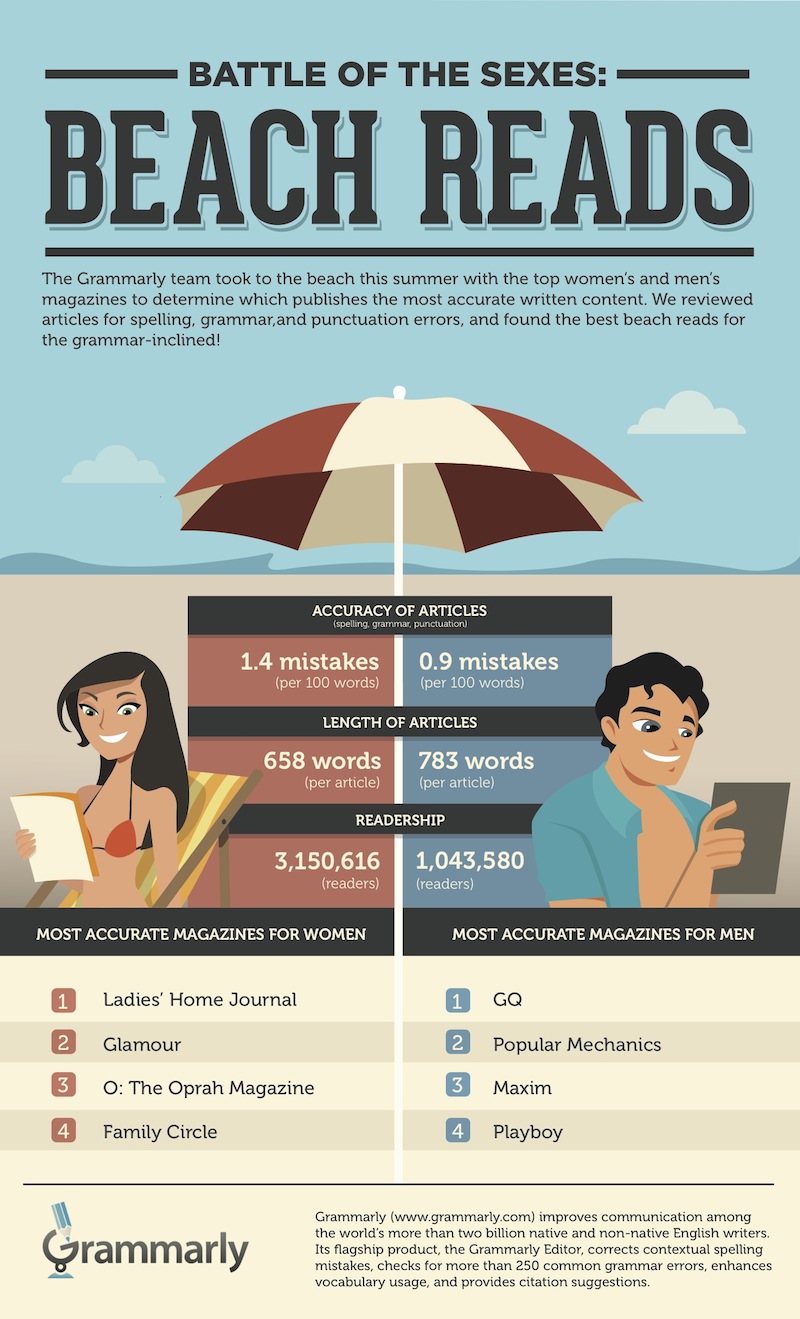
The article raised more questions than answers; the infographic, on the other hand, I found simply baffling. Why take to the beach? Why does the level of readership matter? HOW BIG IS THAT BEACH?
Seriously: that beach goes on for miles behind them, clear to the mountains. That happy, reading, presumably grammar-obsessed couple under the too-small umbrella is not on a beach. They are stranded in a desert.
But more to the point, what was the method for this study? What magazines were included? Was The New Yorker, for example? I've submitted tons and tons of poems -- three -- to The New Yorker and they have never accepted one for publication. Why? They accepted one for their latest issue that wasn't even very good. But they won't accept mine? Once, they accepted this, this, as a poem:
ON THE INEVITABLE DECLINE INTO MEDIOCRITY OF THE POPULAR MUSICIAN WHO ATTAINS A COMFORTABLE MIDDLE AGE
O Sting, where is thy death?
Which is really mean, as a poem, let alone not rhyming. And possibly ungrammatical? I don't know. I tried to check it on Grammarly but it told me that the text was too short to check, so Grammarly doesn't know as much about poetry as The New Yorker. Or maybe they know more, and I should submit my poems to Grammarly?
The point is... um... the point is what magazines did they search out and what grammar mistakes did they find, and do people really read magazines anymore? Sweetie does. Sweetie loves actual paper magazines that come in the mail, usually a day too late and Sweetie can't wait to get them, so sometimes she just goes and buys them, anyway, the result being we get double the number of magazines laying around and I have an alarming amount of information about Khloe Kardashian's marriage.
 |
| 25,000 page views, just like that. |
The article itself was short on news. I did check the article itself on Grammarly, and found that it alerted me to plagiarism, punctuation and style errors, and spelling errors, too -- but didn't specify which because I had to sign up to find out the real problems and when I tried to get the NSA to tell me what my passwords were to all my websites they hung up on me and then I heard a drone hovering over my house so... I gave up.
Grammarly's little check-box did tell me it was looking for unbalanced punctuation, which is not punctuation that is off its meds, as you'd think if you were going to write a conceptual short story about a semicolon that wants to be a real colon and decides to [SPOILER ALERT!] joint the Punctuation Mob only to learn that to become a Made Mark he has to kill his own brother, probably a question mark ?
That last sentence wasn't a question, I was trying to show you Semi's brother, Question Mark ?.
Unbalanced punctuation, you would know if you stopped looking at pictures of Khloe Kardashian
 |
| Am I atop the search engines yet? |
Commas inside closing quotation marks
Periods inside closing quotation marks
Semicolons outside closing quotation marks
Question marks inside closing quotation marks when the quotation is a question
Question marks outside closing quotation mark when the sentence is a question.
Got that last one? I was trying to figure out what you would do if the sentence was a question about a quotation that was also a question, something like:
Was it Macbeth or Hamlet that said "To be or not to be?"?
Then I got to wondering whether that quotation was actually a question. So I looked that up. It's not. The actual quotation is:
To be, or not to be, that is the question:
Including the colon, which I didn't think had even been invented when Roger Bacon was writing all his plays under the pseudonym William Shakespeare. Which is interesting because one of the most famous questions in the world, To be or not to be? isn't even a question -- despite the fact that the speaker (Gandhi) expressly labels it a question!
I mean, weird, right?
You don't think of punctuation as having been invented but it is, of course. Punctuation wasn't created out of whole cloth and gerunds and quarks at the Big Bang, it had to evolve over time, from tiny one-celled periods to complex organisms like the Ampersand.
The colon came out of Latin and Greek, used to mark a limb of a sentence rather than a complete sentence itself, and first became common, according to the Oxford English Dictionary, around 1600. The OED cites this explanation from 1616:
John Bullokar's An English expositor (1616) glosses Colon as "A marke of a sentence not fully ended which is made with two prickes."
Which is only dirty-sounding if you think it is. Another thing that sounds dirty but maybe isn't? Hamlet asks, when pondering why we stay alive when life is so hard (ANSWER: leftover pizza for breakfast):
Who would Fardels bear, To grunt and sweat under a weary life, But that the dread of something after death, The undiscovered Country, from whose bourn No Traveller returns, Puzzles the will, And makes us rather bear those ills we have, Than fly to others that we know not of. Thus Conscience does make Cowards of us all,
The potentially-dirty part of that being Fardels and who is bearing them. You probably don't know what a Fardel is. I certainly don't. I didn't even realize that the point of Hamlet's speech was to point out that Hamlet thinks the only reason we go on living is because we are uncertain what happens after death. We studied that play in high school, and I never got that. Probably because I didn't pay attention. When you worry about how poorly our schools are educating kids nowadays, ask yourself what you learned in school. It probably wasn't grammar.
Or "Fardels."
"Fardels" is medieval archaic language meaning bundle or burden. So Hamlet is just talking about burdens, and you need to get your mind out of the gutter.
As for how the survey was conducted? Your guess is as good as mine. But what I did get out of the survey is that women's magazines are way more likely to have grammar errors -- 1.4 per thousand words! -- than men's magazines, but have 3 times the readership, and not all of that circulation can be attributed to Sweetie's impatience. But maybe we shouldn't get the idea that women are more tolerant of poor grammar. A study found that 4 out of 5 women objected to the ungrammatical phrase "I'll finish it real quick," probably because they knew their husbands were lying.
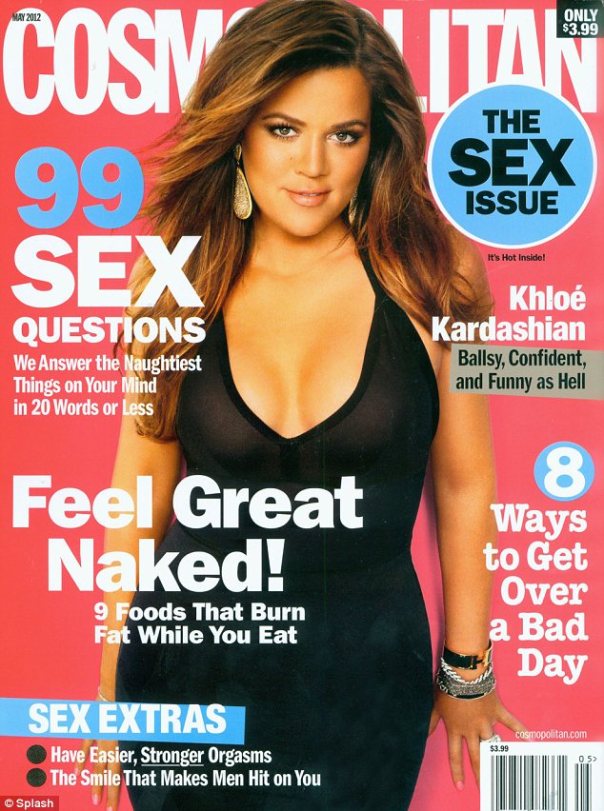 |
| There should probably be a colon after "Feel Great Naked!" |